
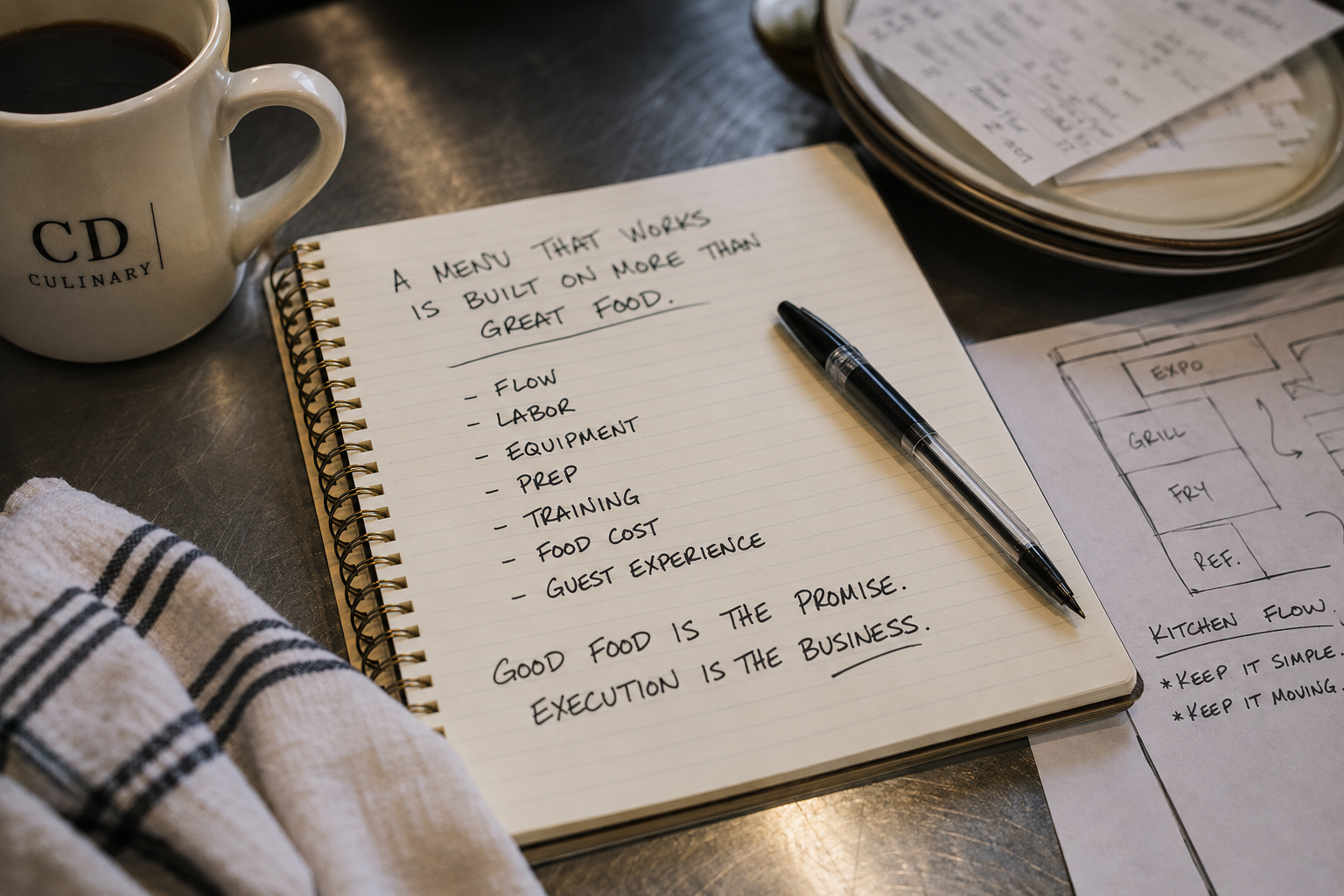
Most people start with the food.
That makes sense. Food is the fun part. It is the part you can taste, photograph, talk about, and get excited over. It is the part that makes people say, “I think this could really work.”
And maybe it can.
But after thirty-plus years in kitchens, I can tell you something pretty plainly:
A menu is not the business plan.
A menu is a promise. The kitchen is where you find out whether you can keep it.
I have seen plenty of good ideas get beat up by reality. Not because the food was bad. Not because the owner did not care. Usually, it happens because nobody asked the boring questions early enough.
How many steps does this item take?
Where does the product live?
How much prep does it require?
Can one cook execute it during a rush?
Does the equipment support the menu, or are we forcing the team to fight the line all day?
Can this be trained?
Can it be repeated?
Can it make money?
Those questions are not glamorous. They do not belong on an Instagram caption. But they are the difference between a restaurant that feels exciting on paper and one that can survive a Friday night.
When I work with someone on menu development, I am not just looking at flavor. Flavor matters, obviously. The food has to be good. But good food alone does not make a good restaurant.
The menu has to fit the concept.
It has to fit the space.
It has to fit the labor model.
It has to fit the equipment.
It has to fit the guest.
And it has to fit the owner’s actual life, not the fantasy version where everyone shows up on time, every station is perfectly staffed, and nothing ever breaks five minutes before service.
That is where a lot of new concepts get into trouble. They build a menu like a wish list. A little breakfast. A little lunch. A little dinner. A coffee program. A few desserts. Maybe some grab-and-go. Maybe a dinner entrée or two because someone said it would be a good idea.
Before long, the menu is trying to be everything to everyone.
The kitchen usually tells the truth first.
The prep list gets too long. Storage gets tight. Ticket times creep up. Labor gets messy. Food cost starts moving in the wrong direction. The team gets frustrated because the system does not make sense.
That does not mean the idea was bad.
It usually means the idea needed structure.
That is the part of this industry I enjoy helping with now. Taking the excitement of a concept and pressure-testing it against real kitchen life. Looking at the menu, the equipment, the flow, the staffing, and the guest experience as one connected thing instead of separate pieces.
Because they are connected.
A sandwich is not just a sandwich. It affects bread storage, refrigeration, prep space, speed of service, packaging, holding quality, waste, training, and station setup.
A coffee program is not just coffee. It affects water, workflow, counter space, electrical needs, ice, refrigeration, guest timing, and how the team moves when the line is full.
A dinner entrée is not just a plate. It affects fire times, plating space, hot holding, dish flow, labor, and whether the kitchen can still breathe when the dining room fills up.
This is why I always want to understand the whole picture before jumping into menu ideas.
What are you trying to build?
Who are you trying to serve?
How fast does it need to be?
How many people will be working?
What equipment do you already have?
What does the space allow?
What does success actually look like?
Once those answers are clear, the menu gets better. Not smaller just for the sake of being smaller. Better. Cleaner. More focused. Easier to execute. Easier to train. Easier to cost. Easier for the guest to understand.
That is not dumbing it down.
That is building it correctly.
Some of the best food in the world is simple food done with discipline. The discipline is the part people underestimate. Anyone can write a menu item. The real work is making sure it can be produced consistently, profitably, and with enough care that the guest feels it.
That is where experience matters.
I have opened restaurants. I have helped fix restaurants. I have built menus that worked and rebuilt menus that did not. I have seen kitchens where the food was beautiful but the flow was brutal. I have seen owners spend money on equipment they did not need while ignoring the bottleneck that was actually hurting them.
I have also seen what happens when the pieces line up.
The team moves better.
The food comes out cleaner.
The guest experience improves.
Waste drops.
Training gets easier.
The owner sleeps a little better.
That is the goal.
Not a menu that looks impressive.
A restaurant that works.
So if you are building a restaurant, adding food to a coffee concept, refreshing a menu, or trying to figure out why your kitchen feels harder than it should, start before the food.
Start with the reality.
Then build the menu around that.
That is where the good stuff usually begins.
-Dale